Information
System
'e-AIMA'
Synoptic
Reference
of Blood Bank
Procedures
Ensure the safe collection, testing, processing, and distribution of blood and its components.
Donors – Screening
- Identification – Verification of Donor ID
- Volunteer Blood Donor Registration
- Questionnaire Completion
- Pending Questionnaire review
- Medical history review
- Recent tattoos or piercings
- Eligibility Criteria
- Brief physical exam
- Blood pressure, hemoglobin level, pulse check
- Recent travel and vaccination status
- Acceptance – Rejection
- Coverage – Blood Assurance
- Grants
Blood Collection
- Process of drawing blood – phlebotomy
- Different types of donation methods are depending on collection type (Whole Blood Donation, Apheresis, Autologous)
- Blood and Blood Component Collection
- Collection and Maintenance of Blood Derivatives
- Blood collection registration
Blood Testing
- Blood goes through testing lab procedures to identify blood type and potential diseases.
- The procedures follow guidelines from National Organizations or WHO.
- Blood Testing includes ABO and Rh blood typing, infectious disease screening, antibody screening
- Centrifugation
- Blood Group
- Molecular Testing
- Serological Testing
- Blood Acceptance – Rejection
Components
- Blood is separated into components by centrifugation (Red Blood Cells (RBCs), Plasma, Platelets)
- Each component is stored under specific standards.
Crossmatching
- Patient’s sample Laboratory Testing – Determinations
- Is an internal laboratory procedure.
- Matches the donor’s blood with the patient’s one.
- Prevents immune reactions.
- Ensures transfusion safety.
- Is mandatory before every transfusion.
Storage and Inventory
- Storage keeps components safe for transfusion.
- Each blood product requires specific storage environment.
- Barcoded tracking system is used for inventory management
- A first-in, first-out (FIFO) protocol is used to prevent wastage.
Blood Transfusion
- Hospitals Blood request is based on patient needs.
- Requests are validated by the hospital’s blood bank personnel.
- Blood bank personnel release the cross matched unit’s volume.
- A proper procedure is followed by personnel to deliver the bug to order clinic.
- A bedside compatibility test is done before transfusion to ensure patient’s safety.
- Emergency Transfusion
- Adverse Reactions
Other
- Blood Units loans – Returns – Repay
- Inter-hospital blood unit transactions
- Blood collection campaigns
- Mobile blood collection drives
- Credit a patient of any hospital by a number of blood units that a donor gave for him, using an inter-hospital exchange network.
Safety and Compliance
- Regular quality control checks
- Staff credentialing and retraining
- Equipment calibration logs
- Incident reporting and review processes
- Total monitoring from collection to transfusion – Traceability
Blood Bank Information System ‘e-AIMA’ is a complete and extensive system. It consists of multiple sub-systems that cover the entire lifecycle of blood, from donor to recipient (vein to vein), with a focus on full resource management. It is integrated, interoperable, secure, and reliable, scalable, centrally controlled, with full traceability.
It fully supports management of donors, patients, test results, blood products, unit cross-matching, transfusions, blood donor associations, blood and blood product stocks, shipments and receptions of units, inter-hospital transactions, and generally any aspect related to blood management.
It totally handles all operations of both hospital blood donation departments, regional blood centers and the National Blood Center Organisation, offering a nationwide blood management coverage.
Cerifications

ISO 9001

ISO 27001

ISO 1348
ISO 45001
ISO 27799

ISO 13485
The advanced and complex procedures of Blood Donation departments require deep knowledge and experience as well as particularly extensive and versatile software.
Blood Bank Information System
Features
- Advanced and intelligent data entry for completing the donor form.
- Component creation before or after the serology test.
- Notification of donor’s historical medical and blood donation records during donor registration.
- Fully customisable donor form, based on the requirements of each blood bank and National standards
- Issue of donor magnetic card.
- Automatic generation of components and calculation of expiry date.
- Blockinng of all components until the serology test is completed.
- Automatic generation of each component label.
- Multiple cross-match for components.
- Failed cross-matches or expired units are blocked for transfusion.
- Real time communication with a HIS and LIS.
- Automatic retrieval of patient information from the HIS and manual entry of them, also.
- Keeps track of all patients’ transfusions and reactions history.
- e-AIMA incorporates powerful functionalities for the required blood exams.
- Efficient storage and retrieval of patient’s tests results.
- Performs haematology, immunology, ABO and serology tests both on units and donors.
- Management of enquiries for transfusion, manually or automatically (via e-AIMA clinics interface module).
- Search for compatible units performing multiple cross match tests.
- Capability to reserve units for more than one patient.
- Label printing for cross matched units.
- Registration of medical staff assigned with the transfusion, begin and end time of transfusion and reactions.
- Produced reports include: adverse reaction report, blood bag reports, clinics enquiries, inventories, donors and patients & donnors lists, etc.
- Production of documents required by legislation.
- Includes a powerful module for generating reports based on user criteria.
- Exporting of all reports in Excel or pdf format.
- Blood Donation Camp, Management and Reporting.
- Sending and receiving of blood units and components among groups of hospitals blood banks.
- Notification for expired or unsuitable blood units (less quantity, reactive, clotting, haemolysis, positive serology tests).
- Vein to vein traceability.
- Remote access capability via Internet.
- Supports unlimited number of users, each with a different level of access and different responsibilities.
- Access privileges per user, role based authority, digital signatures and user activity log files.
- Capability to use RFID bracelets for user identification and digital signature.
- Option for enumeration of units based on ISBT 128 standards
- Consolidation of blood bank facilities and available resources.
- Improves staff efficiency and work volumes by automating the daily workflow.
- Eliminates time-intensive work associated with managing paperwork.
- Full traceability of all operations in the blood bank.
- Provision of required security levels and control/approval points.
- Integration with LIS and HIS systems.
Feature List
- System Integration, Interoperability & Architecture
- It has the ability to interface and interoperability with the corresponding Laboratory Information Systems and Hospital Information Systems.
- It offers independence of system operation for each Hospital.
- It supports the ability of Central Overview at a central level.
- It offers an interface with the Central Blood Bank from mobile units at remote locations.
- It has the ability to issue a referral order for tests at geographically remote units.
- It has the ability to communicate with other information systems.
- Supports interconnectivity of information about blood donors, blood and patients.
- Offers remote access via the Internet.
- Security, Compliance & Access Control
- It supports user roles and rights at the application level.
- It has the ability to access the results only to authorized users from any point of the network.
- Supports compliance with both legislation and relevant EU directives.
- Ensures that each blood donor and unit information is accessible according to roles and access security.
- Records all user actions and supports full traceability.
- Supports users with different responsibilities, access levels and authorization.
- Integrates access rights per user, based on user roles.
- Supports digital signatures as well as user activity logs.
- Supports RFID bracelets, for the identification of users and their digital signature.
- Blood Donor Management
- It supports the use of a smart card for blood donors.
- Blood donor management.
- Blood donor groups management.
- Unit credits for blood donors and blood donor groups.
- Provides management of prospective blood donors to meet the needs of field trips.
- Supports electronic correspondence with registered blood donors.
- Provides the ability to create a selection list of potential prospective blood donors.
- Provides the ability to register a changing list of eligibility criteria for selecting a prospective blood donor.
- Allows users to easily search for data on each blood donor so that their identity and suitability are confirmed before each blood donation.
- Maintains a record of the reasons that made the blood donor temporarily or permanently unavailable/suitable.
- Provides necessary information on previous blood donation history, possible problems and adverse reactions.
- Maintains a historical record of activities of blood donor groups.
- Maintains questionnaires of blood donor.
- Ability to record data related to Blood Donor Counseling for communicable diseases.
- Mobile Blood Drives & Outreach Activities
- Schedule mobile blood drive.
- Supports the planning of trips of mobile blood donation units.
- Contains functions for the management of blood donor associations and blood collection excursions.
- Blood Collection Management
- Blood donation registration.
- Records all important information from the moment of selection and entry of blood donor data to blood collection and transfusion to patients.
- Maintains a record of all blood donations.
- Automatically gives a unique registration number for each blood donation.
- Records day, time, quantity and duration of blood collection.
- Allows selection of reasons for postponing or canceling blood collection.
- Has the ability to manage blood collection types and derivatives.
- Laboratory Testing & Quality Control
- Laboratory tests of blood units.
- Supports the ability to import test results either automatically from the laboratory or from blood donation.
- Ability to record results for Blood Group, RHESUS Factor, Kell Phenotype, Syphilis, Hepatitis B, HbsAg, Hepatitis C, HIV, HTLV, Malaria, CMV, HBV-DNA, HCV-RNA and HIV-RNA.
- Supports internal Quality Control.
- Supports external Quality Control.
- Reagent batch validation.
- Ability to add other optional tests.
- Supports laboratory procedures of Immunohematological and Serological testing.
- Supports the ability to add new serological profiles and phenotypes.
- Allows urgent testing before all blood collection details are fully entered.
- Ability to monitor laboratory tests for the prevention of Mediterranean Anemia and hemoglobinopathies.
- Blood Processing & Component Preparation
- Blood processing.
- Isolation and disposal of unsuitable blood units.
- Offers plasma fractionation.
- Recording of all stages of bottle and derivative processing.
- Has the ability to record completion of the process for each unit.
- Inventory, Logistics & Blood Unit Movements
- Blood stock with the necessary categorization.
- Blood and blood product movement within/outside the hospital.
- Keeps the status of the inventory and orders available for all areas at each workstation.
- Offers management of the stock of blood units and their derivatives.
- Has the ability to warn about the minimum allowable stock.
- Supports receipt and sending of blood and derivatives between Health Units.
- Supports virtual receipts or shipments between Health Units.
- Supports automatic matching of virtual movements to real ones.
- Supports sending and receiving blood units and derivatives between hospital blood banks.
- Monitors the balance of units in the Blood Bank in total and by blood donor, patient and health unit.
- Notifies expiration or unsuitability of a blood unit and monitors its destruction.
- Patient Management, Compatibility & Transfusion
- Patient history.
- Clinic requirements.
- Compatibility check (Cross-matching).
- Supports blood compatibility check for the patient for whom the blood is intended.
- Transfusions.
- Offers management of requests for blood products.
- Provides information for each blood unit reserved for a specific patient.
- Ability to record, analyze and print a report on transfusion results.
- Supports autologous transfusion.
- Records all data of autologous blood collection.
- Reports on the availability of autologous blood quantities.
- Ability to perform clinical and laboratory monitoring of people with Mediterranean Anemia and regular blood transfusions.
- Manages postponements and cancellations.
- Traceability
- Traceability.
- All operations on each blood unit are monitored from collection until transfusion.
- Reporting, Statistics & Analytics
- Reports.
- Provides a tool for creating reports and submitting queries.
- Ability to create reports for the presence of antibodies of particular importance.
- Ability to include a powerful reporting tool based on a graphical work environment.
- Produces reports with information for blood collections, blood products, derivatives, donor eligibility, microbiological results, blood groups, virological tests, correspondence, autotransfusions, plasmapheresis, individuals, groups and organizations.
- Produces statistical reports for blood bank activities.
- Produces required statistical reports of blood collections and infections found.
- Maintains all specified legal books and forms.
- Configuration, Forms, Barcoding & Labeling
- Offers customization, allowing the system administrator to adapt the system to user needs.
- Provides the ability to create a referral form for tests.
- Includes a comprehensive barcode reading system.
- Provides label printing for both samples and blood units.
- Prints blood unit labels based on the ISBT 128 barcoding system.
‘e-AIMA’ is supported by IT engineers, with an extensive expertise and in-depth knowledge of medical informatics. This guarantees unrivalled implementation, training and technical assistance services.
‘Patient Safety’, Blood Bank Information System’s module, makes patients’ transfusions safer by reducing the possibility of errors. It manages all transfusions at the OR and facilitates best practices. It reduces errors, improves quality of care, streamlines clinical workflows and delivers potential cost savings. Based on the cross-matching results, the ‘Patient Safety’ module is able to validate the right blood bag for the right patient.

Step 1 : Scan blood bag’s barcode using your mobile phone
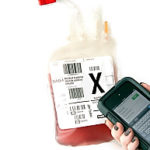
Step 2 : Scan the patient’s id wristband.

The green check on the phone’s screen, assures patient – blood unit compatibility.

The red ‘X’, stops transfusion immediately, preventing any severe situation.
the right blood product, to the right patient
‘Patient Safety’
into your EMR
‘Patient Safety’, Blood Bank Information System’s module, makes patients’ transfusions safer by reducing the possibility of errors. It manages all transfusions at the OR and facilitates best practices. It reduces errors, improves quality of care, streamlines clinical workflows and delivers potential cost savings. Based on the cross-matching results, the ‘Patient Safety’ module is able to validate the right blood bag for the right patient.
Automated safety check stops user procceedings until the risk is resolved. Eliminating errors is the fundamental goal of all health professionals in the Hospital environment. Through the ‘Patient Safety’ software, our solution brings this to the forefront, providing direct connection to blood order and patient’s electronic medical record (EMR).
As a result, the clinical integration solution checks the matching of the laboratory validated blood components that found compatible to patient. In addition, it streamlines the workflow and helps the improvement of patient safety while providing measurable financial benefits. In order to achieve an advanced Transfusion Safety, the corresponding software module utilizes internal checks to:
- Create color-coded flags that signal information which should be reviewed.
Ensure users cannot proceed if the information is missing.
Help prevent transfusing the wrong product with product safety checks.
Display notifications when information is incorrect.
Automated safety check stops transfusion in case component does not match to the patient validated components.
Information System
Improving Quality
Eliminating errors is the fundamental goal of all health professionals in the Hospital environment. Through the ‘Patient Safety’ software platform, our solution brings this to the forefront. Blood Bank Information System ‘e-AIMA’ provides direct connection with the blood orders and the patient’s electronic medical record (EMR).
As a result the clinical integration solution connects the laboratory validated blood components to the receiver patient. In addition it streamlines the workflow and helps the improvement of patient safety while providing measurable financial benefits. In order to achieve an advanced Transfusion Safety, the corresponding software module utilizes internal checks to:
- Create color-coded flags that signal information which should be reviewed.
- Display notifications when information is incorrect.
- Ensure users cannot proceed if the information is missing.
- Help prevent transfusing the wrong product with product safety checks.
- Automated safety checks stop users from moving to the next screen until the risk is resolved.
Benefits of
Blood Bank Information System
- Getting rid of manual procedures.
- Minimization of probability of error.
- More precise and effective Information retrieval.
- Inventory control using the FIFO (First-In-First-Out) concept.
- Reports for any time period of donors, seekers, total consumption of the blood units and overall report.
- Designation of blood in demand but rarely available and which blood group is rarely in demand but plenty in stock.
- Help to identify the main cause for requirement of blood units.
- Identification of which doctor has recommended the blood units.
- Provision of the discarded blood units list and the relative reason.
- Maintain an inventory and the total number of units of a particular blood group.
- Information about units that become unhealthy due to technical fault.
- Check if the replacement donor has actually donated the blood or not.
- Generation of the unique identification number to the donor
- Proposal of the blood unit bags IDs.
- Unit labeling based on ISBT 128
- Support blood donation camp information upload.
Remote support is only a button call away, giving you high-quality service and fast issue resolution.
Increase
Your
Operational
Efectiveness
With our consultancy and expertise in optimizing laboratory workflows, we can help you inrease your operational effectiveness. Our team of specialists are dedicated to improving efficiency and productivity, to accelerate time to case completion, reduce complexity and hands-on time, and deliver faster results. We make it easy to maximize your lab’s performance.

